
Taiwan Is Open to Foreign M&A—With a Defined Rulebook
Foreign buyers often assume Taiwan is a difficult market to acquire in. The reality is more nuanced: for non-PRC investors, Taiwan operates on a principle of "liberalization as the rule, restriction as the exception." Thousands of foreign investments are approved every year, the legal system is transparent, and courts enforce contracts reliably. What Taiwan does require is that virtually every foreign acquisition of a Taiwanese company obtains prior government approval—and buyers who understand the pathway can plan timelines with reasonable confidence.
This guide walks through the approvals a foreign buyer needs, how long each realistically takes, and what well-known precedent transactions teach us. For an overview of who can actually help you execute on the ground, see our companion article: M&A Advisory in Taiwan: A Guide for Foreign Buyers.
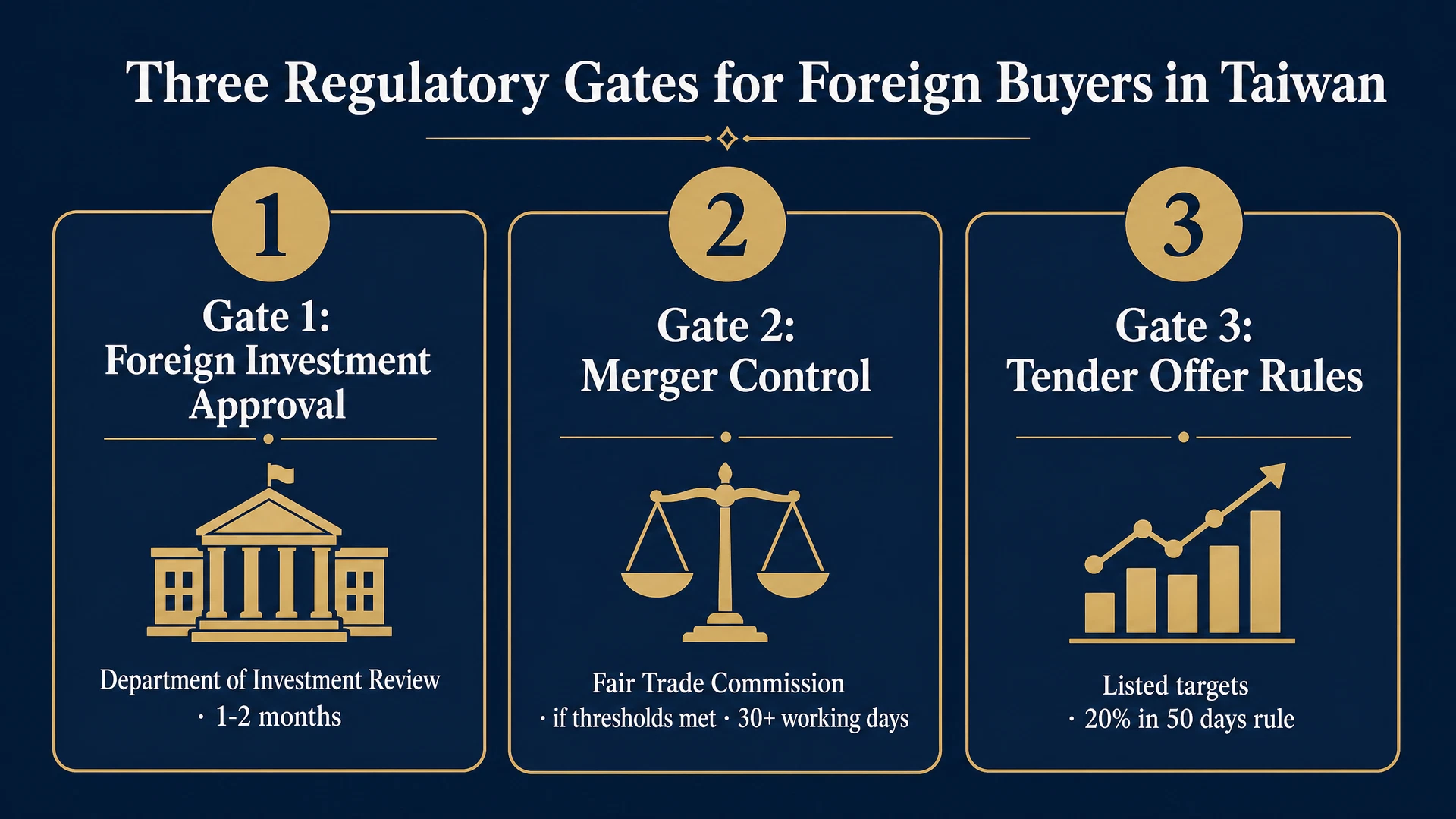
Gate 1: Foreign Investment Approval (FIA) from the Department of Investment Review
The cornerstone of Taiwan's inbound M&A regime is the Statute for Investment by Foreign Nationals. Under it, a foreign investor acquiring shares of a Taiwanese company must obtain Foreign Investment Approval (FIA) from the Department of Investment Review (DIR) under the Ministry of Economic Affairs—the successor to the well-known Investment Commission, reorganized in September 2023—before the investment is made.
Key features of the FIA regime:
- Listed-company exception: acquiring less than 10% of a TWSE- or TPEx-listed company does not require prior FIA; such portfolio investments go through the Foreign Institutional Investor (FINI) registration channel instead. Crossing 10%—or buying any stake in a private company—triggers the FIA requirement.
- Negative list: a small set of industries is prohibited to foreign investment (e.g., defense-related manufacturing) and a longer list is restricted, requiring case-by-case consent (e.g., agriculture, certain utilities, transportation, cable television).
- Regulated sectors: banks, insurers, securities firms, and telecoms additionally need consent from their sector regulator, such as the Financial Supervisory Commission or the National Communications Commission.
- Intra-group restructurings that shift ownership of a Taiwanese subsidiary between foreign entities also require prior DIR approval—a point that frequently surprises multinational buyers.
Realistic timing: straightforward applications by non-PRC investors are typically approved in one to two months; cases involving restricted industries, large transaction values, or complex structures commonly take two to four months. Deals with any PRC nexus are assessed under a far stricter positive-list regime and routinely take six to nine months, with a meaningful risk of rejection. Investors whose ultimate ownership includes PRC shareholders above the 30% threshold (or PRC de facto control) are treated as PRC investors—buyers with mixed cap tables should analyze this early. The DIR remains an active gateway rather than a bottleneck: according to White & Case's 2025 FDI review of Taiwan, the DIR approved over 2,000 foreign investment cases worth roughly US$7.25 billion in the first eleven months of 2024 alone.
Gate 2: Merger Control at the Fair Trade Commission
Independently of FIA, a transaction may require a pre-closing merger filing with the Taiwan Fair Trade Commission (TFTC) if it meets the statutory thresholds, which were raised effective January 2026:
| Threshold Test | Current Standard |
|---|---|
| Combined worldwide turnover | All parties together exceed NT$50 billion, and at least two parties each have Taiwan turnover above NT$3 billion |
| Non-financial single-party test | One party has Taiwan turnover above NT$20 billion and the counterparty above NT$3 billion |
| Financial-sector single-party test | One party has Taiwan turnover above NT$40 billion and the counterparty above NT$3 billion |
| Market-share tests | Combined share reaching 1/3, or a single party holding 1/4, of a relevant market |
The TFTC's initial review period is 30 working days, extendable by up to 60 additional working days for complex cases. In practice, most mid-market SME acquisitions by foreign buyers fall below these thresholds and require no filing—but the analysis should always be documented. Global deals with a Taiwan component (for example, two foreign parents merging while both hold Taiwan subsidiaries) can trigger a filing even when the target itself is small.
Gate 3: Tender Offer Rules for Listed Targets
If your target is listed, Taiwan's Securities and Exchange Act adds a mandatory mechanism: any acquirer who, alone or with related parties, intends to acquire 20% or more of a listed company's shares within 50 days must do so through a public tender offer filed with the FSC. This shapes structuring choices for control transactions—many foreign buyers first build a sub-20% stake or negotiate a share subscription, then launch a tender offer (TOB) for control. Insider-trading and disclosure rules apply from the moment negotiations become concrete.
Gate 4: Sector Regulators—the FSC and the NCC
Beyond the DIR and the Fair Trade Commission, two sector regulators deserve special attention because they hold independent veto power over deals in their industries.
The Financial Supervisory Commission (FSC) must approve any acquisition of, or significant investment in, a bank, insurer, securities firm, or financial holding company. The FSC's posture has been on public display in recent transactions. In 2025, the merger of Taishin Financial and Shin Kong Financial was completed after FSC clearance, while CTBC Financial's competing application to launch a tender offer for Shin Kong was rejected—and in late 2025 the FSC amended its investment rules for financial holding companies (raising the initial stake threshold from 10% toward 25% with cash consideration requirements), signaling a clear preference for consensual, board-supported combinations over hostile approaches (see the IFLR M&A Guide 2026: Taiwan). Another consensual example cleared in the same wave is E.Sun Financial's acquisition of Mercuries Life Insurance, one of 2025's largest domestic deals (see PwC Taiwan's 2026 M&A White Paper release). The lesson for foreign buyers eyeing financial-sector assets: secure board support first, budget extra months for FSC review, and expect scrutiny of funding sources and long-term commitment.
The National Communications Commission (NCC) plays the equivalent role for telecommunications, broadcasting, and media. The benchmark case is Taiwan Mobile's merger with Taiwan Star: announced in December 2021, conditionally approved by the NCC in March 2023, cleared by the Fair Trade Commission with conditions in November 2023, and completed on December 1, 2023—nearly two years from signing to closing (see also Asian Telecom's coverage of the FTC approval). The parallel merger of Far EasTone and Asia Pacific Telecom cleared the NCC on a similar schedule. Foreign ownership caps also apply in these sectors (for example, direct foreign shareholding in wireline/wireless operators is capped, and broadcasting has stricter limits), so telecom and media deals require structuring advice from day one.